[SATIRE] The Real Story Behind the Jeepney Phaseout
The jeepney phaseout has a real story behind the headlines. We look at small operators, the modernization timeline, and what's actually happening.
By Tartanilla
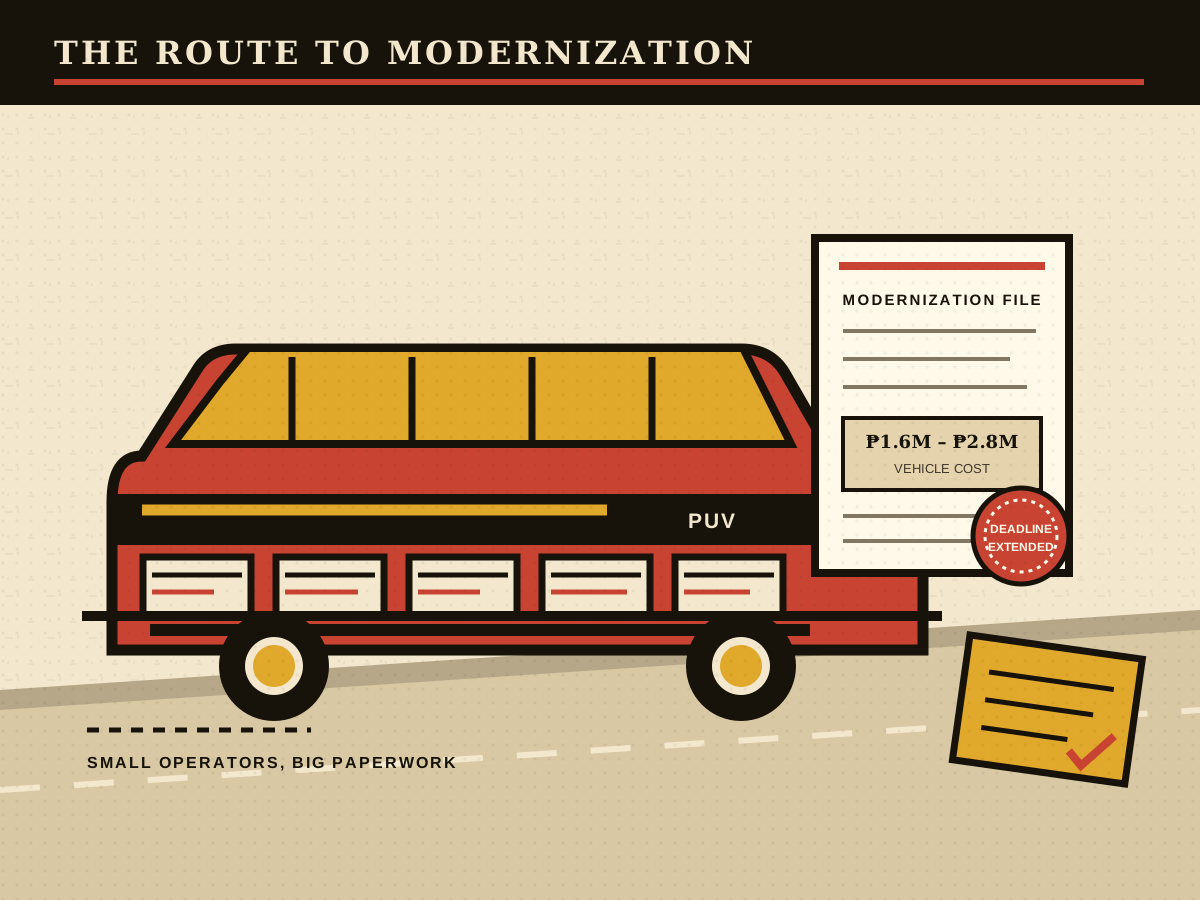 Fig. 06 — The Modernization Route
The Philippine government has replaced the jeepney with a sleek new e-jeep that costs ₱2.8 million and runs on optimism. Operators are asked to form cooperatives immediately. The deadline has been extended seven times.
⚠️ SATIRE DISCLAIMER: This article is satire. The satirical consequences section below is exaggerated for humor. The facts about the jeepney phaseout are real and sourced. We are making fun of the system — not the drivers.
What Actually Happened
The Philippine government launched the Public Utility Vehicle Modernization Program (PUVM) in 2017. It required older jeepneys to be replaced with "modern" PUVs. These new vehicles use Euro 4-compliant engines. Many models are electric.
The goal was real. Old jeepneys produce heavy air pollution. They are fuel-inefficient. Many lack basic safety features. Replacing them made sense in theory.
The problem was the execution. Modern PUVs cost between ₱1.6 million and ₱2.8 million per unit. Most small jeepney operators own one or two units. They bought their jeepneys second-hand for ₱200,000 or less. The gap between what they have and what they need is not a gap — it is a canyon.
The government offered financing through Land Bank and Development Bank of the Philippines. But loan terms required cooperatives, not individual operators. Forming a cooperative takes time, legal documents, and a minimum number of members. Many small operators had never run a business through a cooperative before.
Deadlines for the phaseout were set, extended, reset, re-extended, and reset again. The original 2018 deadline moved to 2020. Then 2022. Then 2023. Then mid-2024. By the time this article was written, some areas had started enforcement while others had not.
[SOURCE: Land Transportation Franchising and Regulatory Board — PUVMP Program Overview: https://ltfrb.gov.ph/puvm/] [SOURCE: verify before publishing] [SOURCE: Philippine Institute for Development Studies — Transport Sector Policy Brief on Jeepney Phaseout, 2022: https://pids.gov.ph/publications/transport-puvmp/] [SOURCE: verify before publishing]
Satirical Consequences [SATIRE SECTION]
First: The cooperative formation process spawns a new government office: the Inter-Agency Committee on Cooperative Paperwork Verification. Its mandate is to verify cooperatives. It requires its own verification body. That body requires its own paperwork.
Second: Old jeepney operators who cannot afford the new units pivot careers. They become tour guides. Their route: a nostalgic "last jeepney ride" experience for city visitors. The fare is ₱500. The aircon is zero. Passengers call it "authentic."
Third: The deadline extension becomes its own tradition. Families gather every six months to watch the announcement. They bring snacks. Children keep score on a whiteboard. The record is seven extensions. The crowd goes wild for number eight.
Finally: The modern e-jeep, when it does arrive, is sleek and air-conditioned. Passengers love it. The only complaint: no Wi-Fi, no charging port, and the route sign says "DISCO" because the operator thought it sounded cool.
Dad Joke
Dad Joke: Why did the jeepney operator join the cooperative?
Because the government said it was the fastest way forward. He has been waiting in line for the paperwork since 2019.
Sources
- LTFRB — Public Utility Vehicle Modernization Program (PUVMP) [SOURCE: verify before publishing]
- PIDS — Transport Sector Policy Brief (2022) [SOURCE: verify before publishing]
- DOTr — PUVMP Progress Reports [SOURCE: verify before publishing]
- RA 7718 — Build-Operate-Transfer Law and its relevance to transport infrastructure
Closing Disclaimer
This article is satire. The jeepney is a genuine part of Philippine culture and livelihood. The operators facing the phaseout are real people facing real financial pressure. We are laughing at the system — not at them.
Reader comments (0)
No comments yet.
More articles
Front page What If?
AI Oscar Winner Sues Academy! Courtroom Drama Explained
An algorithm takes home a statuette, then asks for royalties, representation, and a better cooling system. The lawsuit is a what-if—not a real case.
 Satirical Deep Dives
Taylor Swift's New Album: Is It Just 'Fresh Prince' with More Emo?
A viral theory links Taylor Swift's confessional pop to a beloved TV theme. The resemblance is a punchline, not evidence of a cover or collaboration.
 Pop Culture Misconceptions
TikTok Dance Challenge Becomes 2023 World Cup's New National Anthem
A dance trend makes for a great tournament fantasy. The supposed FIFA announcement, however, belongs in the satire column—not the sports desk.